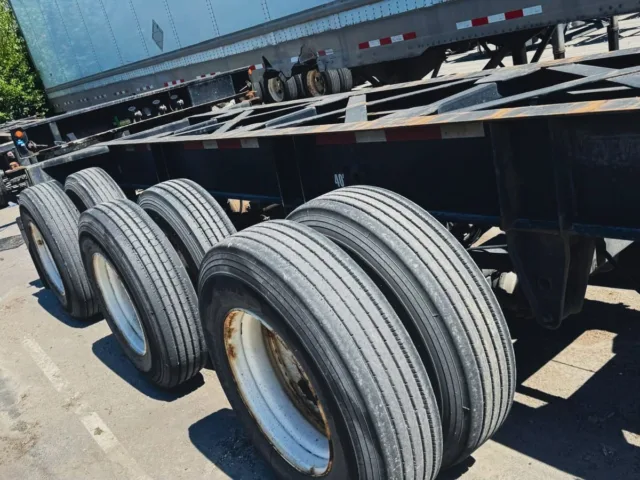
A drayage fleet usually has two kinds of chassis: the ones that work every week, and the ones it needs for a busy spell. Renting suits the second kind. For the first, lease-to-own sits between renting and buying: you make payments over a set term, then a buyout at the end makes the chassis yours.
We offer lease-to-own on trucks, trailers and chassis, and the lessor is named in each agreement. Every offer is written for the deal, so this guide doesn’t quote payments. It explains how lease-to-own works, what the written offer should show, and how to test it against renting and buying with your own numbers.
How lease-to-own works
The steps are the same whether the unit is a 40′ tridem chassis or a dry van:
From quote to ownership
Choose the chassis
Match it to the boxes you move. Our 40′ tridem takes 20 and 40 ft containers, the 20-40-45 tridem 20, 40 and 45 ft, the 40–53 extendable 20, 40 and 53 ft, and the 40′ gooseneck, a tandem, 40 ft.
Get the offer in writing
Term, payment, number of payments, total of payments, the buyout and when you can use it, and taxes. The checklist below has the full list.
Sign the agreement
The lessor is named in each agreement. Read who insures, who maintains and what ending early costs before you sign.
Run it and make the payments
The chassis works in your fleet for the term, licensed, insured and inspected as the agreement and BC’s rules require.
Buy it out
At the end of the term the buyout makes it yours. Check that any registration against it is discharged.
Lease-to-own is not the same as a lease. With a lease you hand the chassis back at the end of the term; with lease-to-own the deal is built around the buyout. It isn’t a loan either: financing is a loan to buy the chassis now, and it comes with its own terms.
Four ways to get a chassis
| Rent | Lease | Lease-to-own | Buy | |
|---|---|---|---|---|
| At the end | You return it | You return it | The buyout makes it yours | It’s yours from day one |
| How long | For the job or the busy spell | A longer term than a rental | The term, then the buyout | As long as you keep it |
| Priced | A custom quote for the job | A custom quote for the term | Payments and buyout in the written offer | The sale price; financing on approved credit |
| Fits | Peaks, one-off jobs, trying a new lane | Steady work, no wish to own | Chassis that work every week, paid over time | You have the cash or financing and want it now |
| Where to start | Chassis rental | Chassis leasing | Lease-to-own | Chassis for sale |
How each one works, in general terms. Your quote or agreement sets the terms of your deal.
What the written offer should show
With custom pricing, the numbers that matter are the ones in your offer. Before you sign anything, check that it answers every line below. Tick them off as you read; the list stays in your browser, and you can print it to take to the meeting.
Before you sign
The lease-to-own offer, line by line
A written offer should answer each of these. If one is missing, ask for it in writing.
18 items to check.
Sources checked 5 Oct 2026. The official sources govern; check them before you rely on a row.
A lease of more than a year is covered by the PPSA
BC’s Personal Property Security Act applies to a lease for a term of more than one year (section 3). That includes a lease that can be ended within a year but has no set term, a shorter lease you keep for more than a year with the lessor’s consent, and a short lease that can renew past a year (section 1). The Act counts the lessor’s interest under such a lease as a purchase-money security interest (section 1), which the lessor can register in the Personal Property Registry.1
When every obligation under the agreement has been performed, you can give the lessor a written demand to discharge the registration (section 50).1 Do it when you pay the buyout, so the chassis is clear if you ever sell it.
How a buyout is structured, a token amount or fair market value, changes the payments and what you own at the end. That’s finance mechanics. Financing through our sister company Blue Capital Equipment Finance Ltd., an affiliated broker, at the same Surrey yard. Its guide to $1-buyout and fair-market-value leases explains the difference.
Lease-to-own or rent? Find your break-even
A rental quoted by the day costs you on the days you have the chassis. A lease-to-own payment is the same every month, however much the chassis works. So the question is simple: how many days a month does this chassis work?
Divide what lease-to-own costs you a month by the days the chassis works, and compare that with your rental quote per day. Compare like with like: if the rental includes tires, repairs or insurance that you’d carry yourself on lease-to-own, put those costs in the second box.
Worksheet: your numbers
Lease-to-own against renting by the day
Your numbers stay in your browser; nothing is saved or sent.
Your result
Lease-to-own cost per working day
—
Break-even: working days a month
—
Renting the same days would cost a month
—
Total to own it: payments plus buyout
—
Fill in your numbers to see the result.
Your own figures only: we don’t fill in prices, and every quote is custom. The total to own leaves out taxes, interest you could earn elsewhere and what the chassis is worth at the end. Not financial advice.
Run it for a slow month and a busy one
Use your quietest month’s days, then your busiest. If lease-to-own only wins in the busy months, the chassis may be a better rental. If it wins even in the quiet ones, it’s a core chassis.
Rent, lease, lease-to-own or buy?
Three questions get you to a starting point. The helper works in your browser and saves nothing.
Decision helper
Which way to get this chassis?
Worked out in your browser; nothing is saved or sent.
If you answer
- For one job or a busy spell
- I don’t know yet
Our suggestion
Rent it
Short jobs and peaks are what renting is for. Tell us the boxes, the terminal and the dates; every quote is custom.
If you answer
- Every week, for a year or more and No, I’d hand it back
Our suggestion
Lease it
Steady work without owning: a longer term than a rental, and the chassis goes back at the end.
If you answer
- Every week, for a year or more and Yes, I want to own it and Payments over a term, then a buyout
Our suggestion
Lease-to-own
Payments over the term, then the buyout makes it yours. The lessor is named in each agreement.
If you answer
- Every week, for a year or more and Yes, I want to own it and All of it now, with cash or financing
Our suggestion
Buy it
It’s yours from day one. Financing goes through our sister company, Blue Capital, on approved credit.
A starting point, not advice: your quotes, your accountant and your lawyer decide.
Compare all three with your own quotes
Have a rental quote, a lease or lease-to-own offer and a purchase price? The calculator puts them side by side over the same months, including what the chassis is worth if you own it at the end.
Your quotes, side by side
Rent, lease or buy the chassis?
Fill in what you were quoted. It works in your browser; nothing is saved or sent.
Cost to date, month by month
Renting costs nothing up front and adds up every month. Buying starts at the price (cash plus what you still owe) and climbs slowly. Where the lines cross, the cheaper path changes.
- Rent
- Lease
- Buy (cash plus balance owed)
| Month | Rent | Lease | Buy |
|---|
The table fills in with your figures.
At the end of the term
The buyout is a decision, not a formality. Put the date in your calendar a few months ahead, look at what similar chassis sell for, and check what yours needs before you take it on as your own.
Worksheet: your numbers
Is the buyout worth taking?
Your numbers stay in your browser.
Your result
What you save by taking the buyout
—
Buyout plus work
—
Fill in your numbers to see the result.
Your own figures only. A negative saving means the buyout costs more. Not financial advice.
Paperwork at the buyout
- The final statement, showing every payment made and the buyout due.
- A bill of sale from the lessor, and the registration transferred into your name with ICBC. Under the Commercial Transport Act, the owner of a trailer or semi-trailer registers it, licenses it and insures it before it’s used on a highway.3
- The discharge of any registration against the chassis in the Personal Property Registry, on written demand if needed.1
- The inspection records. A commercial trailer’s CVI decal runs to the last day of the 12th month after it was issued, and sits on the outside of the left or right lower front corner of the trailer.4
Blue Capital also explains the choices at the end of a lease, from buying out to handing back: see its guide to end-of-lease options.
Where lease-to-own fits in a chassis fleet
Most fleets don’t pick one way for every chassis. A common shape is a core of chassis that work every week, owned, leased or on lease-to-own, with rentals on top for the peaks.
Lease-to-own fits when
- The chassis works most days, on lanes you expect to keep.
- You want to own it in the end, without paying for it all on day one.
- The break-even worksheet says lease-to-own costs less per working day than your rental quote, even in a slow month.
Rent instead when
- The need is a job, a season or a run of heavy weeks.
- You’re trying a lane, a customer or a box length you haven’t moved before.
- You don’t yet know how many days a month the chassis would work.
Sizing the rental buffer for a peak is its own job: the Port of Vancouver drayage playbook has a worksheet for it. And if you haven’t settled on two axles or three, read tridem vs tandem container chassis first.
Calculator
Estimate a lease payment with the end-of-term option you want. Enter your own residual for an FMV or TRAC lease and see…
Page
The whole rental process, from the first quote to the return: what you need, how quotes are priced, pickup or delivery, and…
FAQ
Lease-to-own questions
Who is the lessor on a lease-to-own?
The lessor depends on the deal and is named in each agreement.
Do you publish lease-to-own payments?
No. Payments are custom and written into your offer. Try the lease payment calculator or the break-even worksheet above with your own numbers.
What can I lease to own?
Lease-to-own on trucks, trailers and chassis. Tell us the chassis and the boxes you move on the lease-to-own page.
Is lease-to-own the same as financing?
No. Lease-to-own is an agreement for the unit: you make the payments, then buy it out at the end. Financing is a loan through our sister company, Blue Capital; see lease programs.
Does a lease-to-own chassis need a CVI?
Yes. BC’s inspection rules cover trailers and semi-trailers, and a commercial trailer’s decal runs to the last day of the 12th month after it was issued (Motor Vehicle Act Regulations, Division 25). Your agreement says who books it.