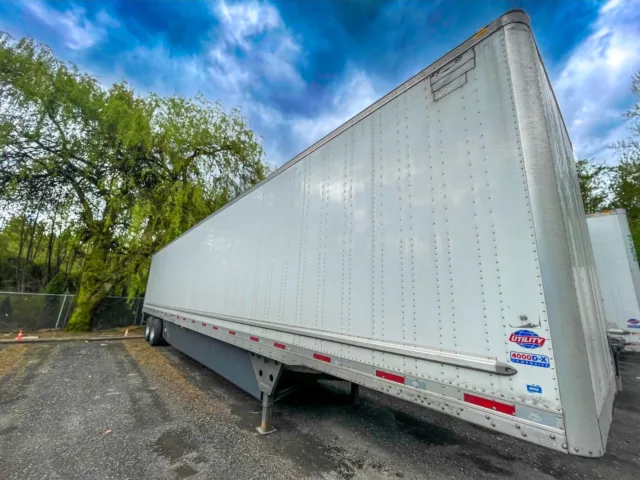
A dry van is the enclosed box trailer that most general freight rides in: pallets, cartons, anything that has to stay dry and loads through the rear doors at a dock. Whether you need one for a contract, a season or for good, the choice is the same three ways: rent it, lease it, or lease it to own it.
We rent and lease dry van trailers from our Surrey yard, and lease-to-own is an option too. This guide covers how to choose between the three, the spec sheet questions to ask about any van, ours included, and the BC rules that apply once it’s hooked up: size and weight, the CVI, cargo securement and the winter chain season.
Rent, lease or lease-to-own?
The difference is how long you need the van and whether you want it at the end. A rental is quoted for the job. A lease runs for a longer term than a rental, and the van goes back at the end. Lease-to-own adds a buyout at the end of the term that makes it yours; the lessor is named in each agreement.
Decision helper
How should you get this van?
Worked out in your browser; nothing is saved or sent.
If you answer
- A job, or a few weeks
- A season, then not and Renting costs less for my months
Our suggestion
Rent it
Tell us how many vans, your dates and where they’re going. Every quote is custom.
If you answer
- A season, then not and The lease costs less
- Most of the year, every year and No, I’d hand it back
Our suggestion
Lease it
Steady work without owning: a longer term than a rental, and the van goes back at the end.
If you answer
- A season, then not and Not yet
Next step
Get both quotes, then run the numbers
Ask for a rental quote for the months you need and a lease quote for a year, then put both in the worksheet.
If you answer
- Most of the year, every year and Yes, over time
Our suggestion
Lease-to-own
Payments over the term, then the buyout makes it yours. The lessor is named in each agreement.
If you answer
- Most of the year, every year and Yes, now
Our suggestion
Buy one
See the vans on the yard now, and the financing options for trailers.
A starting point, not advice: your quotes and your lanes decide.
When does a lease cost less than renting?
If you need a van for part of the year, compare renting for just those months with a year’s lease. The break-even is the number of months where the two cost the same: need the van for more months than that, and the lease costs less.
Worksheet: your numbers
Lease or rent: how many months a year?
Your quotes stay in your browser; nothing is saved or sent.
Your result
Break-even: months a year
—
Renting for your months
—
A year’s lease
—
Difference over the year
—
Fill in your numbers to see the result.
Your own quotes only: we don’t fill in prices, and every quote is custom. Compare quotes that include the same things (insurance, maintenance, delivery). Not financial advice.
Thinking of buying instead? Leasing and buying a trailer also differ in cash flow and tax treatment, and that’s finance mechanics. Financing through our sister company Blue Capital Equipment Finance Ltd., an affiliated broker, at the same Surrey yard. Its guide, should you lease or buy your next trailer?, walks through it.
The spec sheet: what to ask about any van
Two dry vans can look the same from the road and still suit very different freight. Ask for the spec sheet, or read the plates, and get an answer to each line below. Where a BC rule applies, it’s in the last column.
Spec sheet questions for a dry van
| What to ask | What BC’s rules say | |
|---|---|---|
| Length | The semi-trailer’s overall length. | Up to 16.2 m in a tractor semi-trailer combination, just over 53 ft; 23.0 m for the whole combination with a single or tandem drive axle.2 |
| Width | Outside width at the widest point. | 2.6 m without a permit. Mirrors and some devices, such as glad hands and lamps, are left out of the width within set limits.1 |
| Height | Overall height, and the floor height at the rear. | 4.15 m for the vehicle and its load, without a permit, and never above a posted clearance.1 |
| Axles and tires | Tandem? Dual tires or wide-base singles? | Up to 17,000 kg on a tandem axle in a tractor semi-trailer.2 Axle track width rules depend on the tires and when the trailer was built.1 |
| Kingpin and wheelbase | Kingpin setback, and the trailer’s wheelbase. | Kingpin setback within a 2.0 m radius; wheelbase 6.25 m to 12.5 m; effective rear overhang no more than 35% of the wheelbase.2 |
| Inside | Inside length and width, and the door opening’s width and height. | No rule: your tallest and widest loads decide. |
| Walls and tie-downs | Logistics posts or track, at which heights; load bars and straps included? | Cargo must be contained, immobilized or secured so it can’t shift or fall.4 |
| Floor | What the floor is rated for, if forklifts drive in. | No rule: check the rating against your forklift and heaviest pallet. |
| Doors | Swing doors or a roll-up door? | No rule: check the door opening against your docks and your tallest load. |
| Suspension | Air ride or spring? | No rule: ask what your shippers require. |
| Year built | Model year and date of manufacture. | Some trailer rules apply by build date, such as axle track widths.1 |
| Inspection | Date on the CVI decal, and the last inspection report. | A commercial trailer’s decal runs to the last day of the 12th month after it was issued.3 |
Rules: Commercial Transport Regulations (s. 7.05–7.07, Appendix D) and Motor Vehicle Act Regulations (Divisions 25 and 35), checked October 5, 2026.
BC’s size and weight rules for a dry van
A truck pulling a dry van is a tractor semi-trailer combination. Appendix D of BC’s Commercial Transport Regulations sets its dimensions and axle weights; sections 7.05 and 7.06 set height and width for every vehicle.12
16.2m
semi-trailer length, just over 53 ft
4.15m
overall height with the load, about 13 ft 7 in
17,000kg
on a tandem axle (37,479 lb)
Posted signs win
The appendix figures are maximums. Where a sign posted on a highway shows a lower height, length or width, the sign is the limit, and you may not drive past a low clearance sign that is lower than your vehicle without a permit (sections 7.04(5) and 7.05(3)).1
The weights are the most the axle group may carry: the axles, tires and licensed weight can set a lower limit. Our guide to tandem and tridem axle limits goes through them.
The CVI on a dry van
BC’s commercial vehicle inspection rules cover trailers and semi-trailers.3 For a dry van, that means:
- Every 12 months. A commercial trailer’s inspection decal expires on the last day of the 12th month after it was issued. Trailers used with a logging truck or fitted with a dump box are on 6 months.3
- The decal on the trailer. It goes on the outside of the left or right lower front corner, and nobody may drive, operate or park the unit on a highway without an unexpired one.3
- The report on board. A copy of the inspection report is carried in the vehicle while the decal is in force.3
- An interim decal lasts 14 days. A unit that doesn’t meet the standards but isn’t a hazard can get one while the work is done.3
- Inspection at any time. A peace officer or the director can tell the owner, lessee or operator to bring the unit in for inspection, even with a current decal.3
On a rental or a lease, your agreement says who books the inspection. If you own the van, keep its inspection and repair records for the last 3 years you own it and 6 months after you sell it.3 The CVI guide covers the inspection itself, and the compliance centre’s reminders can put the due date in your calendar.
Since September 2, 2025, every CVI is done to the 2025 Vehicle Inspection Manual, which anyone can read free at vsis.ca, so you can check a van against the same standard the inspector uses.7
Licence, insurance and the load
Before a trailer or semi-trailer is used on a BC highway, it’s registered with ICBC, licensed and insured. On a leased one with a lessee, the Commercial Transport Act puts the licence and the insurance on the lessee instead of the owner, and the owner applies to have the lessee named in the registration (section 6).6 Read your agreement for who arranges each, and see our rental insurance requirements if you rent from us.
A closed van doesn’t make a load secure on its own. BC requires cargo to be contained, immobilized or secured so it can’t leak, spill, fall or shift in a way that affects the vehicle’s stability, and it applies National Safety Code Standard 10 to vehicles over 5,000 kg licensed GVW carrying cargo on a highway.4 In a van, that usually means load bars or straps against the posts or track, so check they’re there before you load.
Seasons that change the plan
From October 1 to April 30, a commercial vehicle on a BC highway carries chains. Some routes are exempt from April 1, and the Lower Mainland south of Horseshoe Bay and west of Hope is exempt all season.5 So a van that stays on Lower Mainland runs isn’t affected, but one going up the Coquihalla or over to the Interior needs a truck that carries them.
The 2026–27 chain season
Chain season starts
Commercial vehicles carry chains on BC highways outside the Lower Mainland exemption.5
- Today, Oct 7, 2026
Some routes stop needing chains
The regulation lists routes, on Vancouver Island and the mainland, where chains aren’t needed from April 1 to 30.5
Chain season ends
The carry requirement runs to April 30.5
Source: Motor Vehicle Act Regulations, s. 7.1635, checked October 5, 2026. Spring load restrictions have no set dates: see the compliance centre’s seasons.
Spring brings load restrictions on roads weakened by the thaw, posted road by road with no set dates. The compliance centre’s seasons show what’s in effect now.
Before you take the van: the checklist
Use this at pickup, whether the van is rented, leased or yours. The paperwork rows are BC rules; the rest are the checks that save a load. Your ticks stay in your browser, and you can print the list.
At pickup
Dry van pickup checklist
Paperwork first, then the box, then the running gear.
16 items to check.
Sources checked 5 Oct 2026. The official sources govern; check them before you rely on a row.
The driver’s daily trip inspection covers the running gear in more detail: see the trip inspection checklist in the compliance centre.
Page
The whole rental process, from the first quote to the return: what you need, how quotes are priced, pickup or delivery, and…
Page
The insurance a rental needs, for you and your broker: the minimums, the certificate and how to send it.
FAQ
Dry van questions
Do you rent reefers or flat decks?
No. We rent dry van trailers and container chassis. Reefers and flat decks are for sale when they’re on the yard: see trailers for sale.
Can I lease a dry van, or lease one to own?
Yes. Dry vans rent or lease, and lease-to-own is an option too. The lessor is named in each agreement.
How often does a dry van need a CVI in BC?
A commercial trailer’s inspection decal expires on the last day of the 12th month after it was issued (Motor Vehicle Act Regulations, s. 25.14). Trailers used with a logging truck or with a dump box are on 6 months.
Who licenses and insures a leased trailer?
On a leased trailer with a lessee, the Commercial Transport Act puts the licence and the insurance on the lessee (section 6). Your agreement says who arranges what.
How is a dry van rental priced?
Every rental quote is custom: term, quantity, mileage, delivery and insurance all count. We don’t publish rates. How renting works explains what goes into a quote.