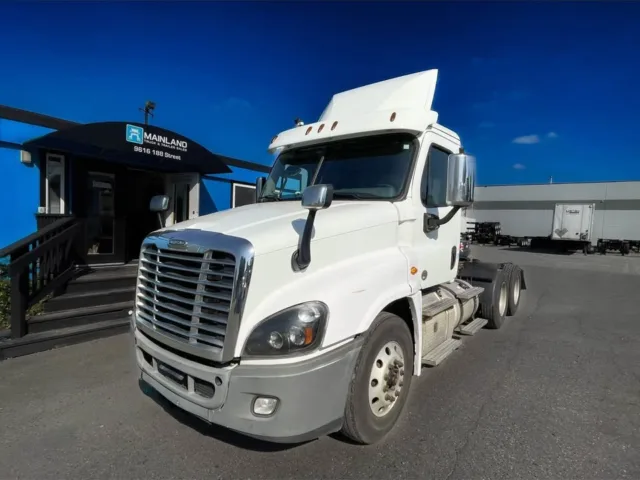
Most people buy their first truck on four numbers: year, make, kilometres and price. By the second, they know those four say little about whether the truck will earn its keep for the next five years. The spec sheet does, if you know how to read it.
Every listing in our used trucks shows its specs as a data plate, in the same order as this guide: identity, powertrain, axles and suspension, cab, dimensions and weights, equipment, warranty and compliance. Work down it line by line, and use the worksheets to turn the numbers into answers.
A “Verified” date on the plate
When a listing shows “Verified” with a date, we checked those specs against the truck itself: its plates, the dash, the ECM or the maker’s build sheet. Specs without it came from the paperwork. Either way, check the lines that matter to you on the truck.
Identity: year, VIN and odometer
Start with the VIN, the 17-character vehicle identification number. The 10th character is the model year and the 9th is a check digit, worked out from the other sixteen, that catches a mistyped VIN.3 The letters I, O and Q are never used.6
The VIN’s 10th character and the model year it stands for
| Model year | Code | Model year | Code |
|---|---|---|---|
| 2015 | F | 2023 | P |
| 2016 | G | 2024 | R |
| 2017 | H | 2025 | S |
| 2018 | J | 2026 | T |
| 2019 | K | 2027 | V |
| 2020 | L | 2028 | W |
| 2021 | M | 2029 | X |
| 2022 | N | 2030 | Y |
49 CFR 565.15, Table VII, up to date as of October 1, 2026; checked October 5, 2026.
The identity lines
| What it tells you | Check before you buy | |
|---|---|---|
| Year | The model year. Engines are certified to the emission standards of their own model year. | That it matches the VIN’s 10th character and the registration. |
| VIN | Make, type, model year and plant, in one code. | That the VIN on the frame, door pillar, dash and compliance label all match the papers. An inspector fails a mismatch. |
| Odometer | Distance in km (miles in small type on our plate). | That it fits the engine hours and the age: see the worksheet below. |
| Engine hours | Time the engine has run, idling included. | Hours that are high for the kilometres mean idling, city work or PTO use. |
| Stock number | Our reference for the unit. | Quote it when you ask about the truck. |
VIN rules: 49 CFR 565.15 and the 2025 Vehicle Inspection Manual (Vehicle Identification), checked October 5, 2026.
Kilometres alone don’t tell you how hard a truck has worked. Idling and slow work add engine hours without kilometres, so put the two together:
Worksheet: your numbers
Kilometres, hours and age
From the data plate. Worked out in your browser.
Your result
Average speed over the engine’s life
—
Kilometres a year
—
Engine hours a year
—
Fill in your numbers to see the result.
Arithmetic on the numbers you enter. The engine’s own records are the real story.
Working the port? A truck joining a Port of Vancouver Truck Licensing System fleet has to be a 2018 model year or newer, so for drayage the year line can rule a truck in or out before anything else.8 Our EPA 2027 guide covers the rule and the model years around it.
Powertrain: engine, emissions and transmission
The engine line gives the maker and model. The two numbers under it matter more: rated horsepower and torque. Torque is the twisting force that gets a load moving and up a grade; horsepower is torque multiplied by engine speed. Some engines have a multi-torque rating with two figures, a lower one and the peak; our plate shows both when the seller gives them (“1,650/1,850 lb-ft”).
Horsepower is also a legal line in BC. Without an overload permit, a combination can weigh no more than 150 kg for each horsepower the towing truck is rated for.1 At the 63,500 kg most a combination can be licensed for, that’s a tractor of at least 424 hp.1
Emissions year
Our plate shows the engine’s emissions year when we have it. It tells you the standard the engine was built to: 200 mg/hp·hr of NOx through model year 2026, 35 mg/hp·hr from model year 2027.54 Makers began using SCR and diesel exhaust fluid (DEF) with model year 2010 engines,5 so on most trucks you look at, the aftertreatment (the DPF, the SCR and the DEF system) is part of what you’re buying: ask for its service history.
Transmission
The plate gives the type (manual, automated manual or automatic), the make and model, and the number of speeds. An automated manual, or AMT, is a manual gearbox that a computer shifts, with no clutch pedal for the driver. Whichever it is, ask for its fault codes and service history, and for the clutch’s history on a manual or an AMT.
Axles: ratio, configuration and ratings
Axle ratio
The rear axle ratio is how many times the driveshaft turns for each turn of the wheels. A numerically lower ratio (2.50, say) turns the engine more slowly at a given road speed; a higher one (3.70) turns it faster and multiplies the torque reaching the wheels. Which suits you depends on your weights, grades and speeds. Work out where the engine will sit at your cruising speed:
Worksheet: your numbers
What RPM will it cruise at?
From the spec sheet and the tire maker’s data. Worked out in your browser.
Your result
Engine speed at cruise
—
With the other ratio
—
Difference
—
Fill in your numbers to see the result.
Engine RPM = km/h ÷ 60 × tire revolutions per km × axle ratio × top gear ratio. Tire wear changes the revolutions a little.
Axle configuration
Shorthand like 6×4 counts wheel positions and then driven positions: a 6×4 tractor has a steer axle and two drive axles; a 6×2 has two rear axles but drives only one; a 4×2 has a single drive axle.
In BC that line can decide what the truck may legally pull. The regulation defines a tandem drive axle as one that sends power to all its wheels, and a combination heavier than 38,000 kg needs a towing vehicle with a tandem or tridem drive axle.1 A single drive axle is allowed only below 38,000 kg.2 The drive axle also has to carry at least 20% of the gross weight.1
Worksheet: your numbers
Can this tractor pull your weight in BC?
Two rules from the Commercial Transport Regulations, checked against the spec sheet.
Your result
Weight per horsepower
—
Horsepower this weight needs
—
Least the drive axles must carry (20%)
—
Fill in your numbers to see the result.
CTR ss. 7.20 and 7.21 only, without an overload permit. Not a ruling: check the regulation or CVSE for your combination.
Axle ratings and suspension
The front and rear axle ratings, in pounds on our plate, are what the maker rates each axle to carry. They cap the legal load too: no axle may carry more than its maker’s rating for the axle, its brakes or its suspension, or more than 9,100 kg (20,062 lb).1 Suspension is listed as air ride, spring or walking beam; ask what condition the air springs and bushings are in.
Weights, wheelbase and the fifth wheel
- GVWR is the maker’s gross vehicle weight rating. Class 8 means a GVWR over 14,968 kg (33,001 lb or more).3 It isn’t the same as the licensed GVW you register the truck for, which sets things like how often it needs a CVI: every 6 months over 17,300 kg.7
- Wheelbase, in inches, is the distance from the steer axle to the centre of the rear axles. A shorter one turns tighter in yards and terminals; a longer one leaves room for a bigger sleeper.
- Fifth wheel: fixed or sliding. A sliding fifth wheel lets you move weight between the steer and drive axles to suit the load.
- Cab: day cab or sleeper, and the sleeper’s size in inches. A day cab is shorter; a sleeper adds a bunk for drivers who are out overnight.
Condition lines: tires, brakes, CVI and warranty
Our plate gives tires and brakes as the percentage left. Read them against what an inspection asks for: at least 3 mm of tread on the front tires and 1.5 mm on the rear of a heavy commercial vehicle, and brake linings of at least 5 mm (strip) or 8 mm (block).6 “CVI valid to” is the date the inspection decal runs out; our CVI guide explains the rules. Warranty lines show any coverage left, by component, to a date or a distance: ask the maker whether it passes to you.
Trailers and chassis: the lines that differ
A trailer or chassis plate swaps the powertrain for the lines that matter on a trailer: length, axles and axle spread, suspension, tare and GVWR, axle ratings and, on a chassis, the container lengths it takes and the number of pins. The axle count and spread decide the legal weight on the group: our tridem vs tandem guide works through it.
The plate’s legal lines, at a glance
Several lines on a truck’s plate meet a BC rule head-on. Keep this beside the listing:
Data plate lines and the rules they meet
| On our plate | The rule it meets | |
|---|---|---|
| Horsepower | The engine’s rated power | No more than 150 kg of combination per rated hp without an overload permit (CTR s. 7.21) |
| Axle configuration | 4×2, 6×2, 6×4, 8×4 … | Over 38,000 kg: a tandem or tridem drive axle that drives all its wheels (CTR ss. 1.01, 7.20) |
| Front and rear axle ratings | The maker’s ratings, in lb | No axle over its maker’s rating or 9,100 kg (20,062 lb) (CTR s. 7.16) |
| GVWR | The maker’s rating; Class 8 is over 33,000 lb | Licensed GVW no more than 63,500 kg (139,994 lb) (CTR s. 7.13) |
| Emissions year | The standard the engine was built to | 200 mg/hp·hr NOx through model year 2026; 35 from 2027 (40 CFR 1036.104) |
| Tires | Tread left, as a percentage | At least 3 mm front and 1.5 mm rear at inspection (VIM 2025, s. 9) |
| Brakes | Lining left, as a percentage | At least 5 mm (strip) or 8 mm (block) at inspection (VIM 2025, s. 3A) |
| CVI valid to | When the inspection decal runs out | Every 6 months over 17,300 kg licensed GVW; 12 months from 8,200 to 17,300 kg (MVA Regulations s. 25.14) |
Commercial Transport Regulations and MVA Regulations Division 25 on BC Laws (current to September 29, 2026); 40 CFR 1036.104 and 49 CFR 565.15 (eCFR); the 2025 Vehicle Inspection Manual. Checked October 5, 2026.
What the spec sheet can’t tell you
The paper shows how a truck was built, not how it was treated. Before you buy, ask for:
- The service records. BC owners keep inspection and repair records for the last 3 years they own a unit and can pass them to the buyer.7
- An ECM report: idle time, fault codes and how the engine has been run.
- An inspection by someone who works for you, with a look at the aftertreatment.
- A lien search on the VIN, so you don’t buy someone else’s loan. Our guide to buying a used semi in BC covers it, with the paperwork.
The right truck makes money. The wrong one loses it slowly, week by week. The spec sheet is where that decision starts.
FAQ
Spec sheet questions
How do I find a truck’s model year from the VIN?
It’s the 10th character. From 2010 the codes run A (2010) to Y (2030), skipping I, O, Q, U and Z: for example J is 2018, N 2022, T 2026 and V 2027 (49 CFR 565.15, Table VII).
Is a 6×2 tractor legal for heavy loads in BC?
Not over 38,000 kg without a permit. The Commercial Transport Regulations require a tandem or tridem drive axle above that weight, and define a tandem drive axle as one that drives all its wheels. A 6×2 drives only one of its two rear axles.
How much horsepower do I need?
Legally, at least one horsepower for every 150 kg of combination weight without an overload permit (CTR s. 7.21): about 424 hp at 63,500 kg. For your routes, the grades and the speeds you run matter as much.
What does Class 8 mean?
A gross vehicle weight rating over 14,968 kg (33,001 lb or more), the heaviest of the US weight classes used on VINs (49 CFR 565.15).
Can you explain a spec on one of your trucks?
Yes. Ask on the truck’s page, by WhatsApp or by phone, and quote its stock number.