



-
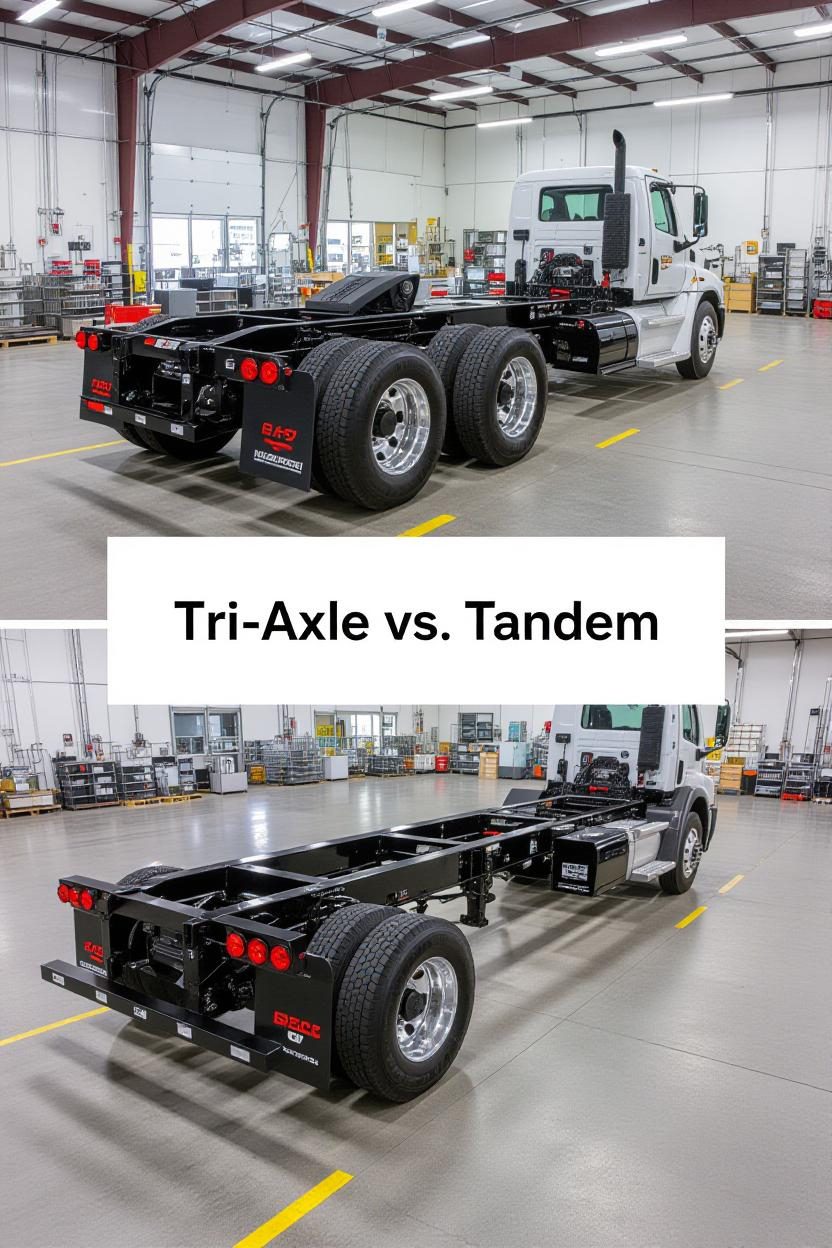
Tri-axle chassis spread weight across three axles, giving you more legal payload headroom, less risk of roadside re-work, and smoother turns on heavy 40s — especially in the Lower Mainland dray lanes. BC Laws
-
If you routinely touch overweight 40’ containers (rail pulls near 60–65k lb cargo) or run steep grades, tri-axles reduce fines, tire/brake heat, and detention from repacks. OOCL
-
Tandems still win for lighter boxes, short city hops, or where the extra tare and cost of a tri-axle won’t pay back.
-
Use a simple break-even: (avoided fees + time saved + claim reduction + uptime) ≥ (extra weekly rate + fuel/toll delta).
-
Extendable 40/45 goosenecks can be specced tandem or tri-axle; they’re worth it if you see 45s or need flexibility. CIE Manufacturing+3cheetahchassis.com+3tritoncontainer.com+3
The weight reality behind your axle choice
British Columbia caps what you can legally carry on each axle and axle group. Practically, that means how you distribute container weight matters as much as the box’s posted net. By adding a third axle, a tri-axle chassis spreads load over three points instead of two, raising the legal window before any one axle exceeds its limit. B.C.’s Commercial Transport Regulations (CTR) set per-axle and axle-group thresholds — for example, a “tridem axle” is defined as three equally spaced axles within a 2.4–3.7 m spread on a semi-trailer, and regulations restrict the gross weight borne by any one axle in a tandem or tridem group. BC Laws+1
Where do overweight risks actually show up? Vancouver-area drayage frequently encounters heavy 40’ imports. Rail operators publish cargo weight thresholds where surcharges kick in (often 60–65k lb cargo for 40/45s), a signal that heavy boxes are common in the flow. If you’re pulling those containers to and from inland ramps or DCs, a tri-axle’s additional capacity margin is your first, simplest risk control. OOCL
The short version
-
Tandem chassis: lighter tare, lower weekly cost, great for standard-weight boxes and dense city cycles.
-
Tri-axle chassis: higher legal headroom per group, reduced repack risk, better compliance buffer on grades and bridge approaches, and fewer headaches at scales.
What the third axle changes (day-to-day)
1) Compliance buffer at scale checks
With two axles, a mis-loaded heavy 40 can push one axle over the limit even if total gross looks “fine.” A tri-axle lets you stay legal longer before any one axle crosses that boundary. The CTR’s axle-group rules are why tri-axles are the go-to for containers near the upper end of posted nets. BC Laws
2) Fewer repacks and terminal re-works
Every re-work burns driver hours, risks cutoffs, and can trigger storage/detention. More legal headroom makes re-work rarer on those 60k-plus cargoes coming off rail. OOCL
3) Tires, brakes, and heat management
Distributing force across three axles reduces per-axle heat and wear on steep connectors in and out of the port/rail grid. It’s not magic — you still need good maintenance — but operators notice fewer hotspots when descending or braking repeatedly on heavy pulls.
4) Insurance and claims
Load shifts and sidewall damage claims trend down when repacks decline and braking is more composed. Your safety score benefits from fewer infractions tied to overload distribution.
When a tandem is still the smartest play
-
Light/medium imports or empties with high turns per day. You’ll save on rental cost and tare weight.
-
Tight alley docks where a slightly shorter wheelbase helps (model-to-model dependent).
-
Routes with conservative posted weights where container nets rarely approach problem thresholds.
In short: tandems maximize speed and cost efficiency when your cargo weights are predictable and comfortably within limits.
The quick math: a break-even you can run on a napkin
Weekly tri-axle premium (vs. tandem)
= Extra weekly rate + incremental fuel/tolls (small)
Weekly avoided costs
= (Average re-work events avoided × (driver hours × hourly cost + storage/detention risk))
-
(Fines/infractions avoided × probability)
-
(Tire/brake wear avoided × your maintenance factor)
-
(On-time pickups protected × your revenue/contract value)
If avoided costs ≥ premium, keep the tri-axle on the lane. If not, standardize on tandems and only upshift for known heavy weeks.
Route and freight patterns that favor tri-axles in Metro Vancouver
-
Rail-to-DC heavy pulls (Annacis, Pitt Meadows, Port Kells) where boxes frequently trend near 60–65k lb cargo; a tri-axle helps stay within axle-group limits and keep your driver schedule intact. OOCL+1
-
Port of Vancouver terminals → inland ramps with grades and short stop-and-go segments, where brake heat management matters.
-
Customer lanes with poor dock staging, where re-works are especially painful because there’s nowhere to shift weight without delays.
Extendable 40/45 goosenecks: where flexibility pays
If your book of business sees a mix of 40s and the occasional 45, an extendable gooseneck avoids sending the wrong tool to the job. These units lock at 40′ and extend for 45′ containers; depending on vendor, they’re available in tandem or tri-axle configurations. Typical spec sheets show closed lengths around 40′-8″/40′-9″ and extended around 45′-8″/45′-9″, meeting major standards (AAR, DOT, FMVSS, ISO, TTMA). That gives you a single asset that covers two common box sizes without compromising compliance. CIE Manufacturing+3cheetahchassis.com+3tritoncontainer.com+3
Regulatory backdrop you should know (without the legalese)
-
Axle groups are king. B.C. defines what counts as a “tridem axle” (three equally spaced axles with a 2.4–3.7 m spread), and then sets limits per axle and per group. Practically, you can’t just think “gross weight”; you must consider what any single axle or adjacent pair is carrying. BC Laws+1
-
Container trucking is a regulated ecosystem around the Port of Vancouver. The Province’s Container Trucking framework exists to keep drayage orderly and fair; understanding those rules helps explain why fleets standardize on certain chassis to avoid non-compliance and delays. British Columbia Government+1
Bottom line: a tri-axle isn’t about “carrying more because it’s bigger”; it’s about staying inside axle-group limits with fewer surprises, especially on heavy 40s common to our region’s import mix. OOCL+1
Field guide: choose your chassis in 5 questions
-
What’s your median 40’ cargo weight?
If you regularly see 60k lb cargo, tri-axle is your default. If most loads are far lighter, a tandem saves cost. OOCL -
How costly is a re-work for your operation?
Include driver time, missed rail cutoffs, storage, and customer penalties. If a single re-work is > the weekly tri premium, your answer is clear. -
Do you cross scales or steep connectors frequently?
Tri-axles smooth braking and heat load when busy corridors and grades are unavoidable. -
Any 45’ traffic or flexibility needs?
Consider an extendable 40/45 gooseneck (tandem or tri) to future-proof inventory without doubling SKUs. cheetahchassis.com+1 -
How sensitive are you to fuel and tolls?
Tri-axle tare is higher, but the delta is small relative to the cost of a single repack or fine in heavy-box lanes.
Mini case: a Surrey fleet’s heavy-box lane
-
Lane: rail ramp → Port Kells DC, 4–6 turns/day.
-
Reality: two heavy boxes/week trigger repacks on tandems.
-
Cost: ~2.5 hr lost per repack (driver + queue), occasional storage day.
-
Switch: tri-axle on that lane only.
-
Result: repacks ≈ 0/month; driver utilization up; premium more than offset by avoided downtime. (Your numbers will differ — run the break-even.)
Action checklist (use this before you order or lease)
-
Pull last 90 days of container nets by lane; sort the top quartile. If the 75th percentile is pushing the rail surcharge thresholds, assume tri-axle exposure. OOCL
-
Map your scales and grades on regular corridors; note where enforcement is common.
-
Quantify a repack (driver hours + detention + risk of cutoffs) — don’t guess.
-
Decide by lane, not company-wide. Blend tandems (light/medium lanes) with tri-axles (heavy lanes).
-
If you see 45s or mixed traffic, price an extendable gooseneck configuration to cut mismatches. cheetahchassis.com+1
-
Confirm compliance prep with your lessor: current CVI, documentation, lights/ABS and tire state before pickup — that’s table stakes.
Why fleets in B.C. choose Mainland for chassis
-
Right tool for your lanes. Tandem, tri-axle, and extendable 40/45 options — we’ll size by your weights, grades, and turns.
-
Compliance-ready. Units prepared to provincial standards and documentation expectations so you’re not learning at the scale house. BC Laws
-
Local, fast swaps. Surrey yard support minutes off Hwy 1.
📞 Call: +1 866-888-6887
📍 Visit: 9616 188 Street, Surrey, BC, V4N 3M2
🔗 Inventory & Quotes: MainlandTTS.com


Comments (46)

www.binance.info注册
November 11, 2025 at 02:48 amThank you for your sharing. I am worried that I lack creative ideas. It is your article that makes me full of hope. Thank you. But, I have a question, can you help me? https://www.binance.info/sk/register?ref=WKAGBF7Y

binance Препоръчителство
December 12, 2025 at 05:29 amYour point of view caught my eye and was very interesting. Thanks. I have a question for you.

7m.cn vn ma cao
December 12, 2025 at 08:28 pmSpecifically looking for 7m.cn vn ma cao information? This site gets it right. Always reliable and easy to use. Give it a try at 7m.cn vn ma cao.

Premia polecajacego Binance
December 12, 2025 at 04:12 amThank you for your sharing. I am worried that I lack creative ideas. It is your article that makes me full of hope. Thank you. But, I have a question, can you help me? https://www.binance.info/register?ref=IXBIAFVY

binance us register
December 12, 2025 at 01:49 pmYour point of view caught my eye and was very interesting. Thanks. I have a question for you.


binance Register
January 01, 2026 at 01:15 amI don't think the title of your article matches the content lol. Just kidding, mainly because I had some doubts after reading the article.

código da binance
January 01, 2026 at 09:02 amYour article helped me a lot, is there any more related content? Thanks! https://accounts.binance.info/ru/register?ref=O9XES6KU

Μπνου αναφορ Binance
January 01, 2026 at 02:05 amCan you be more specific about the content of your article? After reading it, I still have some doubts. Hope you can help me.

binance Sign Up
February 02, 2026 at 10:21 pmCan you be more specific about the content of your article? After reading it, I still have some doubts. Hope you can help me.

nạp tiền qh88 qh88.vet
February 02, 2026 at 06:28 amMais uma opção pra recarregar no QH88! Que a sorte esteja ao seu lado nas apostas. nạp tiền qh88 qh88.vet

tỷ số trực tuyến ma cao
February 02, 2026 at 06:28 amNeed live scores for Macau games in real-time? tỷ số trực tuyến ma cao provides just that! Essential tool for anyone keeping track of Macau matches. This site is clutch! Learn more here: tỷ số trực tuyến ma cao


binance "oppna konto
February 02, 2026 at 06:12 amYour point of view caught my eye and was very interesting. Thanks. I have a question for you.

Binance推荐奖金
March 03, 2026 at 05:13 amCan you be more specific about the content of your article? After reading it, I still have some doubts. Hope you can help me. https://accounts.binance.com/en-ZA/register-person?ref=B4EPR6J0

mounja boost
March 03, 2026 at 05:59 amMounjaBoost is a next-generation, plant-based supplement created to support metabolic activity, encourage natural fat utilization

boostaro
March 03, 2026 at 04:14 amBoostaro is a purpose-built wellness formula created for men who want to strengthen vitality, confidence, and everyday performance.
heroup
March 03, 2026 at 04:21 amHeroUP is a premium mens wellness formula designed to support sustained energy, physical stamina, and everyday confidence.

prodentim
March 03, 2026 at 04:29 amProDentim is a distinctive oral-care formula that pairs targeted probiotics with plant-based ingredients to encourage strong teeth, comfortable gums, and reliably fresh breath.

mitolyn
March 03, 2026 at 04:34 amMitolyn is a carefully developed, plant-based formula created to help support metabolic efficiency and encourage healthy, lasting weight management.
purdentix
March 03, 2026 at 04:50 amPurDentix is a revolutionary oral health supplement designed to support strong teeth and healthy gums. It tackles a wide range of dental concerns

gluco6
March 03, 2026 at 05:38 amGluco6 is a natural, plant-based supplement designed to help maintain healthy blood sugar levels.

arialief
March 03, 2026 at 05:42 amArialief is a carefully developed dietary supplement designed to naturally support individuals dealing with sciatic nerve discomfort while promoting overall nerve wellness.

prostavive
March 03, 2026 at 05:43 amMaintaining prostate health is crucial for men’s overall wellness, especially as they grow older. Conditions like reduced urine flow, interrupted sleep

insuleaf
March 03, 2026 at 05:49 amInsuLeaf is a high-quality, naturally formulated supplement created to help maintain balanced blood glucose, support metabolic health, and boost overall vitality.
prostapeak
March 03, 2026 at 05:50 amProsta Peak is a high-quality prostate wellness supplement formulated with a comprehensive blend of 20+ natural ingredients and essential nutrients to support prostate health
manergy
March 03, 2026 at 05:52 amManergy is an advanced male vitality supplement created to help support healthy testosterone levels
nervegenics
March 03, 2026 at 06:04 amNerveGenics is a naturally formulated nerve-health supplement created to promote nerve comfort, cellular energy support, antioxidant defense

prostafense
March 03, 2026 at 06:05 amProstAfense is a premium, doctor-crafted supplement formulated to maintain optimal prostate function, enhance urinary performance, and support overall male wellness.
aqua sculpt
March 03, 2026 at 06:19 amAquaSculpt is a high-quality metabolic support supplement created to help the body utilize fat more efficiently while maintaining steady, reliable energy levels throughout the day.
nervecalm
March 03, 2026 at 06:19 amNerveCalm is a high-quality nutritional supplement crafted to promote nerve wellness, ease chronic discomfort, and boost everyday vitality.
kerassentials
March 03, 2026 at 06:30 amKerassentials is an entirely natural blend crafted with 4 potent core oils and enriched by 9 complementary oils and vital minerals.
prime biome
March 03, 2026 at 06:54 amThe bodys natural process of skin cell renewal is essential for preserving a smooth, healthy, and youthful-looking complexion.
prosta peak
March 03, 2026 at 07:01 amProsta Peak is a high-quality prostate wellness supplement formulated with a comprehensive blend of 20+ natural ingredients and essential nutrients to support prostate health
prostadine
March 03, 2026 at 07:05 amProstadine concerns can disrupt everyday rhythm with steady discomfort, fueling frustration and a constant hunt for dependable relief.
gl pro
March 03, 2026 at 07:24 amGL Pro is a natural dietary supplement formulated to help maintain steady, healthy blood sugar levels while easing persistent sugar cravings.
nativegut
March 03, 2026 at 07:25 amNativeGut is a precision-crafted nutritional blend designed to nurture your dog’s digestive tract.

nitric boost ultra
March 03, 2026 at 07:54 amNitric Boost Ultra is a daily wellness formula designed to enhance vitality and help support all-around performance.
native gut
March 03, 2026 at 08:10 amNativeGut is a precision-crafted nutritional blend designed to nurture your dog’s digestive tract.
glpro
March 03, 2026 at 08:11 amGL Pro is a natural dietary supplement formulated to help maintain steady, healthy blood sugar levels while easing persistent sugar cravings.
primebiome
March 03, 2026 at 08:13 amThe bodys natural process of skin cell renewal is essential for preserving a smooth, healthy, and youthful-looking complexion.
back biome
March 03, 2026 at 09:11 amBackbiome is a naturally crafted, research-backed daily supplement formulated to gently relieve back tension and soothe sciatic discomfort.

visium pro
March 03, 2026 at 09:27 amVisium Pro is an advanced vision support formula created to help maintain eye health, sharpen visual performance, and provide daily support against modern challenges such as screen exposure and visual fatigue.

viriflow
March 03, 2026 at 09:28 amViriFlow is a dietary supplement formulated to help maintain prostate, bladder, and male reproductive health. Its blend of plant-based ingredients is designed to support urinary comfort and overall wellness as men age.
backbiome
March 03, 2026 at 10:03 amBackbiome is a naturally crafted, research-backed daily supplement formulated to gently relieve back tension and soothe sciatic discomfort.
Post A Comment

Stay ahead in a rapidly world. Subscribe to Prysm Insights,our monthly look at the critical issues facing global business.
breathe
October 10, 2025 at 11:17 am**breathe** breathe is a plant-powered tincture crafted to promote lung performance and enhance your breathing quality.