



Cash, control, and risk—those three variables decide whether a chassis strategy actually makes money in 2025. Buy everything and you’ll tie up capital. Rent everything and you’ll pay a premium for convenience. In a market where interest rates have eased and insurance pricing is softening, but demand still ebbs and flows week-to-week, lease-to-own (LTO) is often the sweet spot: predictable payments, optionality at the end, and fewer surprises than import-dependent purchases. Bank of Canada+1marsh.com+1
Below is a pragmatic, numbers-first guide to evaluating LTO for container chassis on Canada’s West Coast—with the exact formulas, what to negotiate, and how to measure break-even against rentals or purchases. We’ll also ground the math in today’s environment: a Bank of Canada policy rate held at 2.75% (as of July 30, 2025), commercial insurance pricing in Canada down ~4% in Q2, and used truck values stabilizing (a signal for residuals in adjacent equipment categories). Bank of Canada+1marsh.com+1ACT Research
Why LTO shines this year
1) Rates are no longer your enemy. With the Bank of Canada holding at 2.75% and signalling caution rather than tightening, lease costs are more predictable—and in many cases lower than 2023–2024 peaks. That improves the monthly payment math for LTO compared with straight rentals. Bank of Canada+1
2) Insurance tailwinds help your total cost of use. Marsh’s Q2 2025 index shows composite insurance pricing in Canada down ~4% year-over-year—part of a broader global easing trend. Softer insurance helps your per-turn economics and makes “owning over time” less punitive than it was in the hard market. marsh.com+1
3) Residuals look sturdier than a year ago. While chassis data is niche, the used heavy truck market—a bellwether for equipment values—has stabilized, with ACT Research noting improving volumes/prices into mid-2025. Healthier resale conditions support an LTO strategy because your buyout value is less likely to be underwater. ACT Research+1
4) You still keep flexibility. LTO structures can include seasonal payment curves, swap rights, and optional early buyouts. That’s crucial when you’re managing variability from vessel bunching, rail service changes, or short contract windows.
The four numbers that decide your LTO economics
Think of every chassis decision as a tug-of-war across four levers:
-
Monthly Payment (P): Your baseline lease cost—ideally aligned to seasonality.
-
Operating Cost (O): Tires, brakes, compliance, storage, and admin. Track fuel separately (tractor), but include yard/terminal storage that the chassis decision influences. To benchmark volatility drivers—like diesel for shuttle miles—use NRCan weekly dashboards for up-to-date pricing rather than last year’s averages. Natural Resources Canada+1
-
Utilization (U): Days-in-use per month or container turns per month.
-
Residual/Buyout (R): Your end-of-term option price or expected market value if you intend to flip the asset.
From these, derive two working metrics:
-
Equivalent Daily Cost (EDC):
EDC=P+OU\text{EDC} = \frac{P + O}{U}
Compare this to your rental day rate; if EDC is consistently lower at your expected U, LTO beats renting.
-
Cost per Container Turn (CPT):
CPT=P+O−Residual CreditTerm MonthsTurns per Month\text{CPT} = \frac{P + O – \frac{\text{Residual Credit}}{\text{Term Months}}}{\text{Turns per Month}}
Where Residual Credit is the portion of expected resale/buyout benefit you attribute back into the term.
Tip: Build these two KPIs into a one-page worksheet. Every time your rail schedule shifts or your detention/storage changes, update U and rerun the comparison.
A simple break-even approach you can trust
To keep it practical, use a conservative example. Suppose your all-in monthly lease payment is $600, you estimate $150 for maintenance/storage/admin, and you expect 18 active days of use per month on average.
-
Total monthly cost: $600 + $150 = $750
-
EDC: $750 / 18 = $41.67/day
If comparable rentals are, say, $45–$55/day (varies by spec, term, and market), then the break-even utilization is roughly 17–18 days per month. Above that, LTO is cheaper per day than renting; below it, rentals win on flexibility. (Swap your own numbers into the same math before you decide.)
Pro move: Re-run the EDC at 15 days and 22 days. Your decision policy might be: “If forecast U ≥ 18 for 2 consecutive cycles, shift volume from rentals into LTO; if U ≤ 15, reverse it.”
Lease-to-own vs. straight lease vs. rental: where each wins
Choose LTO when…
-
You have a stable baseline of container turns and want to capture ownership value without tying up cash on day one.
-
You operate across predictable lanes (e.g., consistent Vancouver/Surrey dray) and value documentation continuity for insurers and audits.
-
You can secure favorable buyout terms (see below) and anticipate healthy residuals.
Choose straight operating leases when…
-
You want predictable payments and maintenance bundling but don’t need a buyout option.
-
You’re likely to swap specs (e.g., shift between tri-dem and extendable pools) as customer mix evolves.
Choose rentals when…
-
You’re covering short bursts (project freight, vessel bunching, blitz weeks) or testing new routings.
-
You want maximum flex with minimal paperwork.
-
Your utilization is too lumpy to justify LTO or leases.
What to negotiate in an LTO—line by line
-
Buyout structure:
-
Fixed Price Buyout (e.g., dollar buyout or set figure): simplifies planning and puts a floor under residual risk.
-
FMV Buyout: can be attractive if residuals look rich and you want the option to walk away. Pin down the appraisal method up front.
-
-
Seasonality curve:
-
Use step, seasonal, or skip-pay options to match your peak season (e.g., Q4 retail) and thin months. This keeps cashflow honest and avoids compounding interest in low-utilization periods.
-
-
Maintenance & tire program:
-
Clarity on what’s included (tread depth thresholds, brake wear) prevents nickel-and-diming and improves uptime during CVSA blitz weeks.
-
-
Swap rights & downtime credits:
-
If a unit requires shop time, you want fast swaps instead of parked drivers. Lock in response SLAs and loaner availability.
-
-
Insurance requirements:
-
Confirm physical damage and liability thresholds with your broker (who may be quoting into a softer market this year) before you sign. Lower rates should appear in the pro-forma. marsh.com+1
-
-
Documentation package:
-
Ensure you’ll receive serial/build sheets, inspections, and GPS logs as part of the lease record. This reduces friction with insurers, auditors, and border agents.
-
-
Early buyout and add-on units:
-
Pre-define early buyout math and a rate card for adding units rapidly (so your next surge doesn’t trigger a fresh negotiation).
-
Accounting lens (IFRS/ASPE): what your CFO will ask
Under IFRS 16, most leases longer than 12 months appear on balance sheet for lessees, with a right-of-use (ROU) asset and a lease liability recognized. Even if you’re a private company on ASPE, your lender may still prefer IFRS-style metrics in covenant tests. Two implications: (1) Debt-like optics from leases are normal in 2025; and (2) comparing “own vs. lease” purely on balance-sheet presentation is less useful than it once was—focus instead on cash profile, residual risk, and utilization. IFRS+1
A one-page worksheet you can use every quarter
Create a living file with five sections:
A) Demand & Utilization
-
Forecast days-in-use and turns per month by lane.
-
Track detention/storage weekly—if it spikes, you likely need short-term rentals on top of your LTO core.
B) Cost Inputs
-
Lease payment P (reflecting any seasonal steps).
-
Operating costs O (tires, brakes, storage, admin).
-
Fuel benchmark (for shuttle miles): pull the latest NRCan weekly diesel series to avoid stale assumptions. Natural Resources Canada
C) EDC & CPT
-
Compute EDC and CPT monthly; compare with your rental rate and with last quarter’s actuals.
D) Residual Plan
-
Note expected buyout value (R) and calendar the decision date (e.g., 90 days before term end).
-
Capture market comps you see (auctions, dealer quotes, trade-ins)—if the curve looks strong, you might exercise the buyout and keep the asset.
E) Risk & Policy Notes
-
Briefly record tariff or compliance watch-items that could affect future pricing/availability (e.g., U.S. AD/CVD actions on certain chassis origins). Keeping a log reduces surprise later. (If you dray into the U.S., maintain Canadian-built chassis and documentation for clean crossings.)
Case study (composite of real outcomes)
The situation: A Lower Mainland fleet running steady Vancouver dray plus periodic cross-border moves. They were renting 25–30 chassis during peaks and holding only a small owned pool.
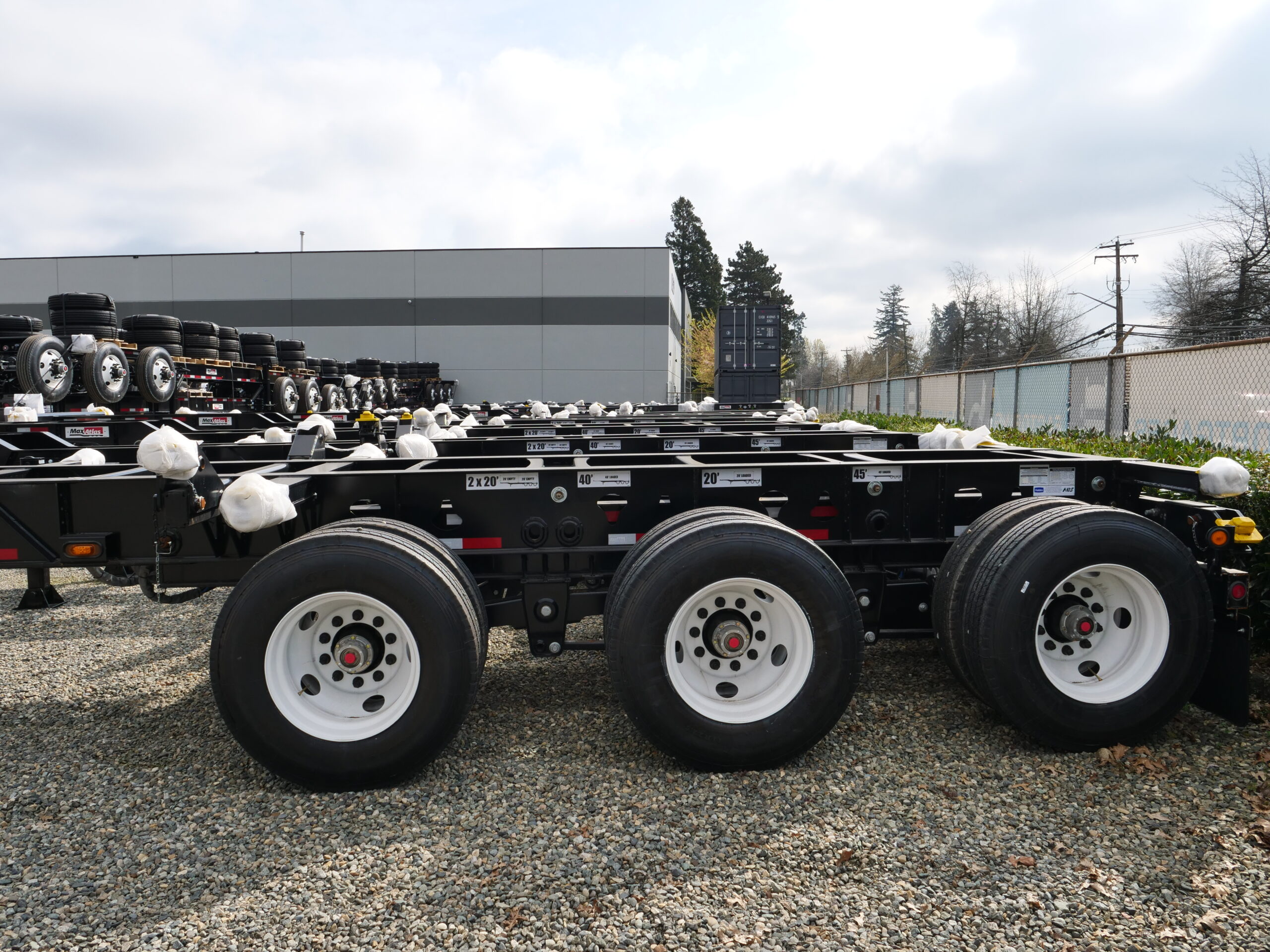
The move: We structured an LTO for 20 Canadian-built Max-Atlas tri-dem chassis with (a) seasonal payments that tapered in January–February; (b) fixed buyout at term; (c) maintenance & tire thresholds aligned to CVSA expectations; and (d) swap SLAs within 24 hours. We left a rental buffer of 10 units for vessel bunching weeks.
The result (first 120 days):
-
Equivalent daily cost ran 8–12% lower than their average rental rate at 19–21 days of use.
-
Detention/storage dropped meaningfully because units were staged closer to the terminal on predictable windows.
-
Insurance broker provided a modest rate improvement at renewal, citing better documentation and maintenance records—helped by the standardized LTO package. marsh.com
Why Mainland’s LTO works in the real world
-
Canadian-made, fully documented chassis. We supply Max-Atlas units—built in Canada, with North American steel and traceable documentation. That simplifies insurer conversations and, if you dray into the U.S., reduces origin-related friction.
-
Authorized dealer advantage. As Max-Atlas’s B.C. dealer, we can match spec to lane (20/40/45 tri-dem, extendable, B-train configs), stage units near terminal or inland depots, and keep parts/service tight.
-
Finance optionality. LTO, straight operating leases, and lease-to-own with early buyout—plus a rental bench for spikes.
-
Inspection-friendly ops. Every unit carries inspection logs and GPS histories—useful for safety, audits, and insurer underwriting.
-
Aligned to 2025 reality. We price and plan against current macro signals: BoC’s rate hold, a softer insurance market, and steadier residuals. Bank of Canadamarsh.comACT Research
Implementation checklist (do these this week)
-
Run the EDC math on your last two months with your actual utilization.
-
Lock in a seasonal payment curve that mirrors your busiest eight weeks.
-
Define swap SLAs (hours, not days) to keep drivers moving.
-
Standardize documentation (serial/build sheets, inspections, GPS logs) in a shared drive for insurers and border queries.
-
Keep a 10–20% rental buffer for surprise weeks; scale it up/down every billing cycle.
-
Calendar the buyout decision at T-90 days with current market comps (auctions/dealer quotes).
-
Refresh fuel and insurance inputs monthly using NRCan and your broker updates so your model stays honest. Natural Resources Canadamarsh.com
The bottom line
In 2025, lease-to-own is often the lowest-risk path to permanent chassis capacity: lower per-day cost than renting at moderate-high utilization, less capital drag than buying, and more control over maintenance, documentation, and residual outcomes. Layer a small rental buffer on top, and you’ve got a chassis strategy that breathes with your business instead of fighting it.
Let’s model your break-even and structure an LTO that fits your lanes.
📍 9616 188 Street, Surrey, BC V4N 3M2 • ✉️ sales@mainlandtts.ca • ☎️ 1-866-888-6887
Sources (selected)
-
Bank of Canada: Policy interest rate held at 2.75% (Announcement & MPR, July 30, 2025). Bank of Canada+1
-
Marsh: Global Insurance Market Index (Q2 2025) and Canada composite rate change (~-4%). marsh.com+1
-
ACT Research: Used truck market updates indicating stabilization/improvement in mid-2025. ACT Research+1
-
NRCan: Weekly diesel pricing and transportation fuel dashboards (for budgeting and scenario analysis). Natural Resources Canada+1
-
IFRS Foundation: IFRS 16 Leases (summary and standard text) for on-balance-sheet treatment of most leases >12 months. IFRS+1


Comments (27)


binance
December 12, 2025 at 10:25 pmThanks for sharing. I read many of your blog posts, cool, your blog is very good.

binance US-registrera
December 12, 2025 at 02:41 amCan you be more specific about the content of your article? After reading it, I still have some doubts. Hope you can help me.

binance create account
December 12, 2025 at 03:27 amYour point of view caught my eye and was very interesting. Thanks. I have a question for you. https://accounts.binance.info/da-DK/register-person?ref=V3MG69RO

binance
December 12, 2025 at 07:45 amYour point of view caught my eye and was very interesting. Thanks. I have a question for you. https://accounts.binance.info/es/register?ref=RQUR4BEO

sodocasinoearthgang
December 12, 2025 at 08:29 pmSodo Casino Earthgang, huh? Never heard of it. Is it legit? Should give it a try. See for yourself: sodocasinoearthgang


binance Norādījuma kods
January 01, 2026 at 07:00 pmYour article helped me a lot, is there any more related content? Thanks!

boostaro
February 02, 2026 at 11:03 am**boostaro** Boostaro is a purpose-built wellness formula created for men who want to strengthen vitality, confidence, and everyday performance.

mounja boost
February 02, 2026 at 12:20 pm**mounja boost** MounjaBoost is a next-generation, plant-based supplement created to support metabolic activity, encourage natural fat utilization, and elevate daily energywithout extreme dieting or exhausting workout routines.

aqua sculpt
February 02, 2026 at 12:50 pm**aqua sculpt** aquasculpt is a premium metabolism-support supplement thoughtfully developed to help promote efficient fat utilization and steadier daily energy.

herpafend
February 02, 2026 at 01:35 pm**herpafend** Herpafend is a natural wellness formula developed for individuals experiencing symptoms related to the herpes simplex virus. It is designed to help reduce the intensity and frequency of flare-ups while supporting the bodys immune defenses.

men balance pro
February 02, 2026 at 04:32 pm**men balance pro** MEN Balance Pro is a high-quality dietary supplement developed with research-informed support to help men maintain healthy prostate function.

neurosharp
February 02, 2026 at 06:01 pm**neurosharp** Neuro Sharp is an advanced cognitive support formula designed to help you stay mentally sharp, focused, and confident throughout your day.

binance h"anvisning
February 02, 2026 at 01:29 pmThank you for your sharing. I am worried that I lack creative ideas. It is your article that makes me full of hope. Thank you. But, I have a question, can you help me?

100 USDT алу шн тркелу
February 02, 2026 at 07:12 amYour point of view caught my eye and was very interesting. Thanks. I have a question for you. https://www.binance.com/es-MX/register?ref=GJY4VW8W

"oppna ett binance-konto
February 02, 2026 at 10:26 pmThanks for sharing. I read many of your blog posts, cool, your blog is very good.

"oppna binance-konto
February 02, 2026 at 09:48 amThanks for sharing. I read many of your blog posts, cool, your blog is very good. https://www.binance.com/register?ref=IXBIAFVY

miglior codice di riferimento binance
February 02, 2026 at 08:39 pmYour article helped me a lot, is there any more related content? Thanks! https://accounts.binance.info/fr-AF/register-person?ref=JHQQKNKN

最佳Binance推荐代码
February 02, 2026 at 08:31 pmThank you for your sharing. I am worried that I lack creative ideas. It is your article that makes me full of hope. Thank you. But, I have a question, can you help me?

注册免费账户
February 02, 2026 at 07:29 amYour point of view caught my eye and was very interesting. Thanks. I have a question for you.

abrir conta na binance
February 02, 2026 at 03:25 amThank you for your sharing. I am worried that I lack creative ideas. It is your article that makes me full of hope. Thank you. But, I have a question, can you help me? https://accounts.binance.info/da-DK/register?ref=V3MG69RO

backbiome
March 03, 2026 at 10:21 pm**backbiome** Backbiome is a naturally crafted, research-backed daily supplement formulated to gently relieve back tension and soothe sciatic discomfort.

prostafense
March 03, 2026 at 10:59 am**prostafense** ProstAfense is a premium, doctor-crafted supplement formulated to maintain optimal prostate function, enhance urinary performance, and support overall male wellness.
nerve calm
March 03, 2026 at 01:44 pm**nerve calm** NerveCalm is a high-quality nutritional supplement crafted to promote nerve wellness, ease chronic discomfort, and boost everyday vitality.

skapa binance-konto
March 03, 2026 at 11:03 amI don't think the title of your article matches the content lol. Just kidding, mainly because I had some doubts after reading the article.
Post A Comment

Stay ahead in a rapidly world. Subscribe to Prysm Insights,our monthly look at the critical issues facing global business.
mindvault
October 10, 2025 at 04:34 pm**mindvault** mindvault is a premium cognitive support formula created for adults 45+. It’s thoughtfully designed to help maintain clear thinking