



If your boxes touch Vancouver or Prince Rupert in 2025, you don’t just need more chassis—you need the right chassis strategy. Freight is recovering, railroads are investing, and the Port of Vancouver’s next big expansion is officially moving through procurement. But the next two to three years will still be defined by variability—vessel bunching, seasonal dwell, shifting intermodal schedules, and evolving trade policy. In this environment, renting or leasing Canadian-made container chassis is the simplest way to add capacity quickly while protecting cash and minimizing tariff risk. Business in Vancouverconstructconnect.com
The market backdrop: stronger gateways, still-variable flows
Vancouver is back in growth mode. The Vancouver Fraser Port Authority reported 3.47 million TEU in 2024—an 11% rebound from 2023—as container trade returned to a steadier trajectory after several turbulent years. That’s not just a headline; it’s a signal that peak-season demand and port operations are normalizing around higher baselines again. GlobeNewswire
Prince Rupert is resilient and recalibrating. The port handled ~739,000 TEU at DP World’s Fairview Terminal in 2024, +5% year-over-year, even after rail and labor-related disruptions earlier in the year. For shippers balancing Vancouver and Rupert routings, that reliability matters—especially if you’re staging chassis to catch specific train windows inland. Prince Rupert Port
Longer-term capacity is coming—but not tomorrow. The Port of Vancouver’s Roberts Bank Terminal 2 (RBT2) has formally moved into procurement (RFQ issued July 2025). Once built, it adds ~2.4 million TEU of container capacity—roughly a 30–50% uplift for the West Coast gateway—with major construction planned to start in 2028 and operations expected in the mid-2030s. That’s fantastic news for Canada’s trade resilience. In the meantime, the only way to absorb near-term growth is to work smarter with the assets we have—including flexible chassis pools. Business in Vancouverconstructconnect.comgCaptain
Rail capacity is being reinforced where you need it. In May 2025, CN announced C$615 million in British Columbia capital projects to boost fluidity through the Vancouver corridor and build capacity from Prince Rupert across Western Canada, part of a C$3.4B systemwide program. For fleet managers, that means better turn times if you can reliably meet those service windows—something rental chassis help you do without over-committing capital. GlobeNewswireProgressive Railroading
Cross-border lanes are evolving. CPKC and CSX launched the Southeast Mexico Express (SMX) in December 2024 to speed automotive and intermodal flows. If you’re testing Mexico-linked routings or rejigging inland ramps, chassis flexibility is the difference between “we can try that lane” and “we need to wait for next budget.” CSXProgressive Railroading
Why chassis rentals & leases beat outright purchases in 2025
1) Agility for uneven weeks. Even as volumes stabilize, week-to-week variability remains real—think blank sailings, vessel bunching, or a string of weather days. A rental pool lets you surge 10–30% for two or three cycles without a purchase order, lead time, or resale risk.
2) Staging for rail service windows. When railroads add or adjust service, you want chassis staged at the right yard, not just any yard. Rentals give you the freedom to position assets close to terminals, inland depots, or customer docks and then redeploy them as schedules shift.
3) Cash protection while rates normalize. If you’re still modeling rate and utilization uncertainty, rentals and operating leases keep your balance sheet light until you see the actual turns—and they avoid the headache of disposing surplus equipment if the market surprises you.
4) Maintenance and documentation advantages. Modern rental programs bring GPS tracking, documented inspections, and preventive maintenance baked in. That improves insurer conversations and reduces safety-related downtime without adding internal admin load.
5) Tariff and origin risk management. For any fleet touching U.S. lanes, the tariff landscape on Chinese-origin chassis continues to be actively enforced (Commerce initiated another covered-merchandise inquiry in April 2025). Renting or leasing Canadian-made chassis is a clean way to avoid unpleasant surprises at the border—or on your landed-cost spreadsheet. Federal Register
Policy clarity you can bank on: Canada’s anti-circumvention decision
In May 2025, the Canada Border Services Agency concluded its first anti-circumvention case related to Vietnam-origin container chassis, determining that imports from Vietnam were not circumventing Canada’s measures against Chinese chassis. For Canadian buyers, that decision removes a layer of near-term uncertainty—but it doesn’t change the reality that U.S. AD/CVD measures on Chinese chassis remain in force, and U.S. enforcement activity has continued into 2025. In short: domestically built chassis with robust documentation remain the safest cross-border choice. Canada Border Services Agency+1Federal Register
The Canadian-made advantage (and why Mainland leans into it)
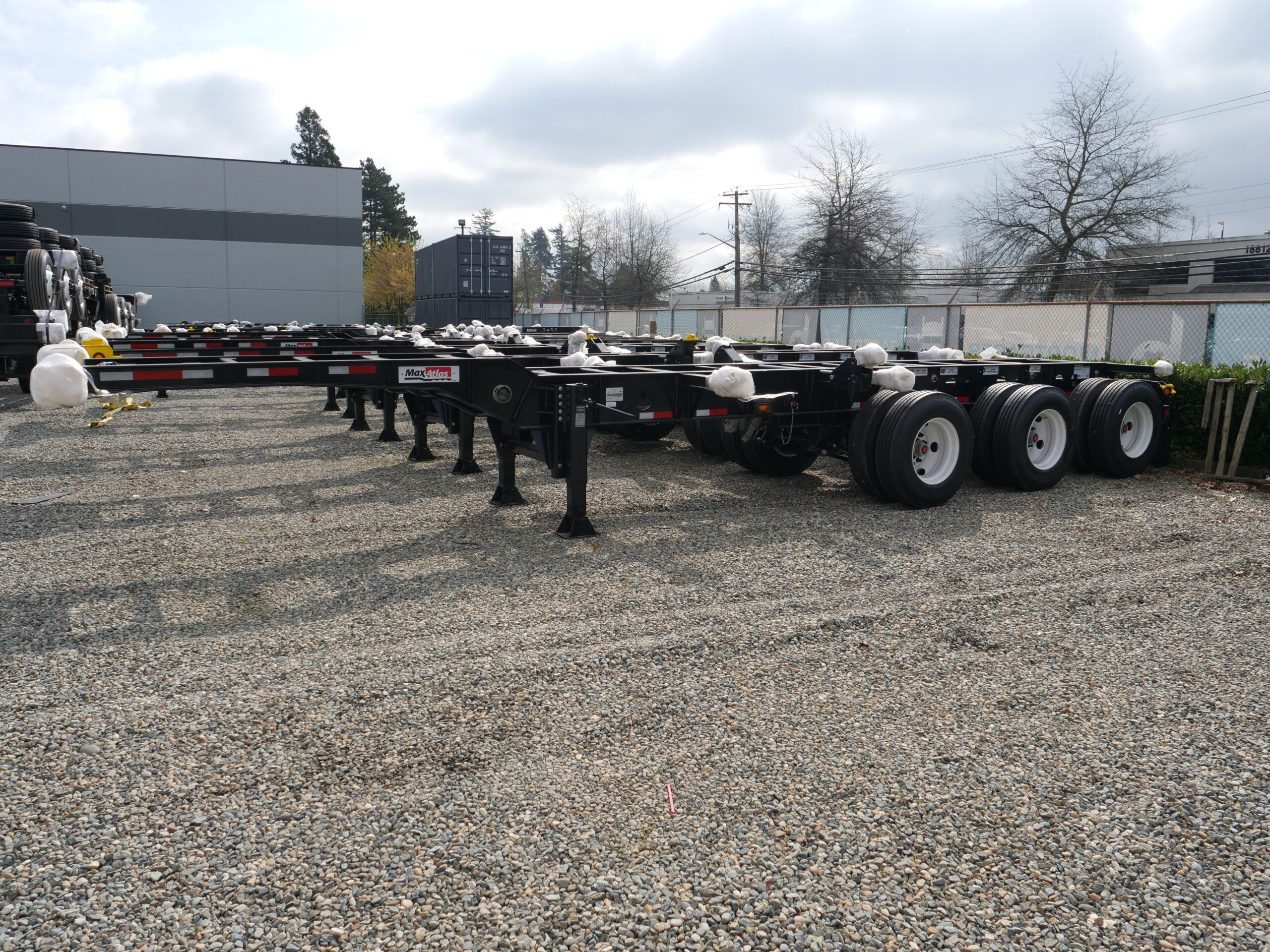
The cleanest way to de-risk your chassis program is to source equipment that’s built in Canada, with high-quality North American steel and full traceability. Max-Atlas International fits that brief—and Mainland Truck and Trailer Sales & Leasing is Max-Atlas’s authorized dealer for British Columbia, meaning you get rapid access to new builds, parts, and support without trans-Pacific lead times. If you need to scale capacity for two months—or two years—we can match the spec to the job (20/40/45 tri-dems, extendables, B-train configurations, and more) and align delivery with your rail windows. Max Atlas+1
Rental or lease? A pragmatic framework
Choose rentals when:
-
Your move plan has short bursts (seasonal retail, grain pushes, project freight).
-
You’re trialing new routings (Rupert vs. Vancouver, or U.S. inland ramps) and want fast reversibility.
-
You’re covering for unexpected downtime (shop time, inspections) without idling drivers.
Choose operating leases when:
-
You’ve got a stable baseline of container turns month-in, month-out.
-
You want lower monthly costs than short-term rentals, plus scheduled maintenance and inspections.
-
You value lease-to-own flexibility without committing day one.
Consider purchasing when:
-
Utilization is consistently high and your duty cycles are predictable.
-
You have the in-house capacity to manage maintenance, inspections, and resale timing.
-
You operate primarily in domestic lanes with minimal policy/entry risk.
Tip: Because fuel and insurance are your two big operating-cost swing factors, anchor your budget to weekly diesel dashboards and current broker feedback, then stress-test ±10%. It keeps “paper savings” from melting away in the real world. Natural Resources Canada
A 10-step playbook to build a chassis buffer without overbuying
-
Map the pinch points. Pull the last 90 days of container turns, detention, and storage. Flag the three worst weeks and quantify how many extra chassis would have erased those costs.
-
Split your pool. Stage a core pool at your yard and a tactical pool closer to terminals/inland ramps. Cutting one shuttle per day per unit is real money.
-
Right-size the buffer. Start with a 10–15% rental buffer on top of your steady-state requirement; scale up/down every two cycles.
-
Align to rail schedules. CN’s B.C. investments are aimed precisely at Vancouver/Prince Rupert fluidity. If service windows are moving, your chassis should move with them. We’ll help place units where they shave the most minutes off your path. GlobeNewswire
-
Tariff-proof cross-border lanes. If any portion of your network runs into the U.S., prioritize Canadian-made chassis with complete documentation. It reduces questions at the border and future-proofs your cost base against enforcement surprises. Federal Register
-
Keep documentation tight. Rental/lease programs should include inspection reports, GPS histories, and maintenance logs. That’s useful for insurers—and invaluable during roadside checks.
-
Create a “hot-swap” protocol. If a unit needs deeper work, swapping the chassis (not the schedule) is the fastest way to protect driver time and on-time performance.
-
Pilot, then scale. Deploy a small rental pool for two billing cycles. If your detention/storage drops the way the model predicted, scale the pool; if not, adjust location and spec.
-
Blend in ZEV pilots where it pencils. For short-haul/urban use, Canada’s iMHZEV program can defray part of the upgrade cost, whether you purchase or lease eligible vehicles (12-month minimum). If you’re evaluating future-proof yard tractors or local-haul units, we can time chassis availability to match vehicle deliveries. Transport Canada
-
Review quarterly. Treat your chassis pool like a living portfolio. As RBT2 progresses and rail service evolves, keep the pool flexible—rent when you need agility; lease when the baseline is clear.
Case example (composite of real-world scenarios)
-
The profile: A Lower Mainland importer with swings tied to Asia-U.S. retail calendars. Historically, dwell spikes and vessel bunching caused 3–4 ugly weeks per quarter.
-
The approach: We staged a 12-unit rental buffer near the terminal and 8 units at the customer’s yard. We coordinated starts around rail cutoffs and vessel ETAs, and used Canadian-made Max-Atlas units to support a cross-border dray subfleet without tariff concerns.
-
The outcome in 60 days: Detention costs fell by 28%, shuttle miles dropped, and the customer avoided a capital purchase that would have sat idle six weeks later. Because it was a rental pool, the fleet shrank back to baseline after the surge without a resale event.
What makes Mainland different in this market
-
Authorized Max-Atlas partner. You get Canadian-built chassis with North American steel, strong documentation, and rapid parts/service support. That matters for insurance, compliance, and cross-border certainty. Max Atlas
-
A bench designed for agility. Our rental and lease fleets include 20/40/45 tri-dems, extendables, and B-train-friendly configurations staged across the Lower Mainland so you can add capacity this week, not next quarter.
-
Placement around rail windows. With CN investing for more fluid Vancouver/Rupert corridors, we help you stage chassis precisely where they’ll translate into better turns. GlobeNewswire
-
Paperwork that helps you pass audits. GPS on every unit, documented inspections, and maintenance logs—organized so your safety and insurance teams can find what they need fast.
-
Scalable terms. Daily/weekly/monthly rentals, multi-month leases, and lease-to-own pathways if you want to convert units after you’ve proven the demand.
Looking ahead: capacity is a choice, not a waiting game
It’s easy to look at the mid-2030s RBT2 operations date and think the capacity crunch will resolve itself later. But trade doesn’t wait. The gateways are busier again, railroads are investing upstream, and cross-border enforcement on Chinese-origin chassis remains active. The fleets that win the next 12–18 months will be the ones that lock in flexible, tariff-proof chassis capacity now—and keep that capacity nimble as schedules evolve. constructconnect.comFederal Register
About Mainland Truck and Trailer Sales & Leasing
We help Western Canadian shippers and carriers scale fast with Canadian-made container chassis—available to rent, lease, or buy—plus dry vans and specialty trailers. We stage equipment across the Lower Mainland and align deliveries with rail and vessel windows so your drivers catch the boxes, not the backlog.
Let’s build your Q4/Q1 chassis plan.
📍 9616 188 Street, Surrey, BC V4N 3M2 • ✉️ sales@mainlandtts.ca • ☎️ 1-866-888-6887
Sources (selected)
-
Port of Vancouver 2024: 3.47M TEU (+11% y/y). GlobeNewswire
-
Prince Rupert 2024: ~739k TEU at Fairview (+5% y/y). Prince Rupert Port
-
RBT2 procurement and timeline: RFQ July 2025; construction targeted for 2028; operations mid-2030s; +2.4M TEU capacity. Business in Vancouverconstructconnect.comgCaptain
-
CN investments: C$615M in B.C. as part of 2025 capex; C$3.4B systemwide. GlobeNewswireProgressive Railroading
-
CPKC-CSX SMX service: Launched Dec 1, 2024; faster intermodal transit across the Southeast–Mexico corridor. CSXProgressive Railroading
-
U.S. AD/CVD enforcement (chassis): Covered-merchandise inquiry initiated Apr 3, 2025. Federal Register
-
CBSA anti-circumvention (Vietnam): Final no circumvention determination, May 23, 2025. Canada Border Services Agency+1
-
Diesel price benchmarking: NRCan weekly dashboards. Natural Resources Canada
-
iMHZEV program (fleet ZEV pilots): Up to $200,000 per eligible vehicle (≥12-month lease/purchase). Transport Canada
-
Max-Atlas (Canadian manufacturer) and BC dealer listing: Company site; Mainland listed as BC dealer. Max Atlas+1


Comments (25)


binance register
December 12, 2025 at 07:58 amThanks for sharing. I read many of your blog posts, cool, your blog is very good.

đăng ký w88 linkvaow88 net
December 12, 2025 at 08:29 pmSigned up for W88 through linkvaow88 net. Smooth process, got my bonus and I'm ready to roll. Give it a shot: đăng ký w88 linkvaow88 net


Création de compte Binance
January 01, 2026 at 01:58 pmI don't think the title of your article matches the content lol. Just kidding, mainly because I had some doubts after reading the article.

jilibetsotlogin
January 01, 2026 at 05:18 pmTrying out Jilibetsotlogin .SOT login process has to be smooth. Gotta link up all my accounts, you know? One account for everything is the dream! Login here: jilibetsotlogin

no1jilibetcasinologin
January 01, 2026 at 05:18 pmNo1jilibetcasinologin is legit! Smooth gameplay and secure access. My go-to for online casino fun! Easy login at no1jilibetcasinologin.

slotomaniaslots
January 01, 2026 at 05:18 pmLooking for a new slot game to try! How are the selection of slots on Slotomania? Anyone know if they have a good selection of progressive jackpots? Check out more slots: slotomaniaslots

Create a free account
January 01, 2026 at 12:20 pmI don't think the title of your article matches the content lol. Just kidding, mainly because I had some doubts after reading the article. https://www.binance.info/pt-PT/register?ref=KDN7HDOR


mitolyn official
January 01, 2026 at 07:58 am**mitolyn official** Mitolyn is a carefully developed, plant-based formula created to help support metabolic efficiency and encourage healthy, lasting weight management.

free binance account
January 01, 2026 at 01:40 pmYour point of view caught my eye and was very interesting. Thanks. I have a question for you.

Anonymous
February 02, 2026 at 01:00 pmThanks for sharing. I read many of your blog posts, cool, your blog is very good.

binance
February 02, 2026 at 10:26 amThank you for your sharing. I am worried that I lack creative ideas. It is your article that makes me full of hope. Thank you. But, I have a question, can you help me?

創建binance帳戶
February 02, 2026 at 11:11 pmThank you for your sharing. I am worried that I lack creative ideas. It is your article that makes me full of hope. Thank you. But, I have a question, can you help me?

Реферальная программа binance
February 02, 2026 at 07:19 pmYour point of view caught my eye and was very interesting. Thanks. I have a question for you. https://accounts.binance.com/vi/register-person?ref=MFN0EVO1

binance register
March 03, 2026 at 04:55 pmThank you for your sharing. I am worried that I lack creative ideas. It is your article that makes me full of hope. Thank you. But, I have a question, can you help me? https://accounts.binance.info/zh-TC/register-person?ref=DCKLL1YD

binance Konto er"offnen
March 03, 2026 at 07:47 amThank you for your sharing. I am worried that I lack creative ideas. It is your article that makes me full of hope. Thank you. But, I have a question, can you help me? https://www.binance.com/register?ref=QCGZMHR6

binance konto skapande
March 03, 2026 at 11:17 amThanks for sharing. I read many of your blog posts, cool, your blog is very good.

binance
March 03, 2026 at 01:06 amYour point of view caught my eye and was very interesting. Thanks. I have a question for you.

binance Registrera dig
March 03, 2026 at 07:17 pmThank you for your sharing. I am worried that I lack creative ideas. It is your article that makes me full of hope. Thank you. But, I have a question, can you help me? https://accounts.binance.com/uk-UA/register-person?ref=XZNNWTW7

backbiome
March 03, 2026 at 01:51 am**backbiome** Backbiome is a naturally crafted, research-backed daily supplement formulated to gently relieve back tension and soothe sciatic discomfort.
Post A Comment

Stay ahead in a rapidly world. Subscribe to Prysm Insights,our monthly look at the critical issues facing global business.
mind vault
October 10, 2025 at 04:35 pm**mind vault** mind vault is a premium cognitive support formula created for adults 45+. It’s thoughtfully designed to help maintain clear thinking